Showing posts with label antebellum novels. Show all posts

Monday, August 11, 2025

The Right to Write

 SLAVERY in HISTORY 

Charleston, SC and slavery books 
 

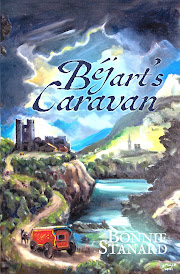
Why am I not surprised to see the above headline? Maybe it’s because of my experience as the author of four historical fiction novels that tell the story of whites and slaves on a Southern plantation in 1857.


Before self-publishing, I queried a number of literary agents seeking a representative for my work. Two of them told me (a white woman) that they could not sell the manuscript in New York because there were slaves in the story. Maybe my books aren’t good books, but to have them rejected because of the subject matter doesn’t give me a chance, even if they’re excellent books. How has compassionate socialism turned into political correctness and worse, repression? 


Our media spurns Putin’s decision to rewrite Russian history, as if we aren’t doing the same thing. According to The Conversation, “New Russian high school textbooks … attempt to whitewash Stalinist crimes and rehabilitate the Soviet Union’s legacy.”


In particular, Russian history is being revised to “gloss over Stalin’s Terror and other truths.”

From the History News Network:
Now you see him, now you don’t. Stalin was a past master at the art of airbrushing. In one classic set of photographs, there Stalin is with his secret police chief, Nikolai Yezhov — and in the next photo, there Yezhov isn’t (he was executed in 1940, with his boss’s approval). And now, in Vladimir Putin’s Russia, the airbrushing of history seems to be all the rage again.

Are we Americans trying to airbrush our history of slavery? A fiction novel set in the antebellum South either conforms to certain social strictures or it doesn’t get published by legacy publishers, regardless of the merit of the writing. When our history is ugly, no good is served by suppressing it.


Monday, November 6, 2023

appropriation

 Cultural appropriation is censorship by another name


One of the sessions at the SC Writers Association’s conference Saturday allowed writers to read aloud their query letter to a panel of three literary agents for critique. I made a mistake. Because I hadn’t read the directions carefully, I arrived with a pitch instead of a query letter, which I read anyway despite my embarrassment.


However, I couldn’t have been as disappointed with my critique as another writer who actually read a query letter. Her book, the subject of the letter, involved a story with a slave.


The subject of “appropriation” dominated the agents’ comments. Appropriation in writing is commonly understood to mean that a writer adopts customs, behavior, habits, etc., of a culture that’s not their own in producing a book. For example a white writer produces a story about a black, or a Latino writes about an Asian.


The writer at the conference who read her query letter before the panel was cautioned that we have to be careful in today’s environment. By the time the agents finished their cautionary statements, it was clear that the writer’s book had no chance of being published. The problem was her color. She was white and her story involved a black slave.


When it comes to cultural appropriation, a distinction should be made between historical fiction and contemporary fiction. It is easier to understand that ethnic groups have a right to claim their story as it exists today. Who better to understand the traditions, language, and ideas than one of their own members?


But historical fiction is another matter. The most contentious issue today is that blacks claim ownership of their history as slaves. The argument goes that they were the ones who suffered and no white (or yellow or red) person can understand this. But how can a black person living in the 21st Century understand what their ancestors underwent over a hundred years ago?


A white writer has as much access to the Slave Narratives and slave autobiographies as a black writer. When you come to think of it, one of the most powerful books written about slavery was written by a white woman. Historians credit Uncle Tom’s Cabin by Harriet Beecher Stowe with galvanizing the abolition movement. Are we to say she had no right to write this book?


Restricting historical fiction novels to certain authors based on ethnicity limits our perspective, imagination, concepts and understandings. The losers here are not just whites but black, reds, and yellows, the entire spectrum of literature.


"Query Letter" panel of literary agents


Sunday, November 6, 2022

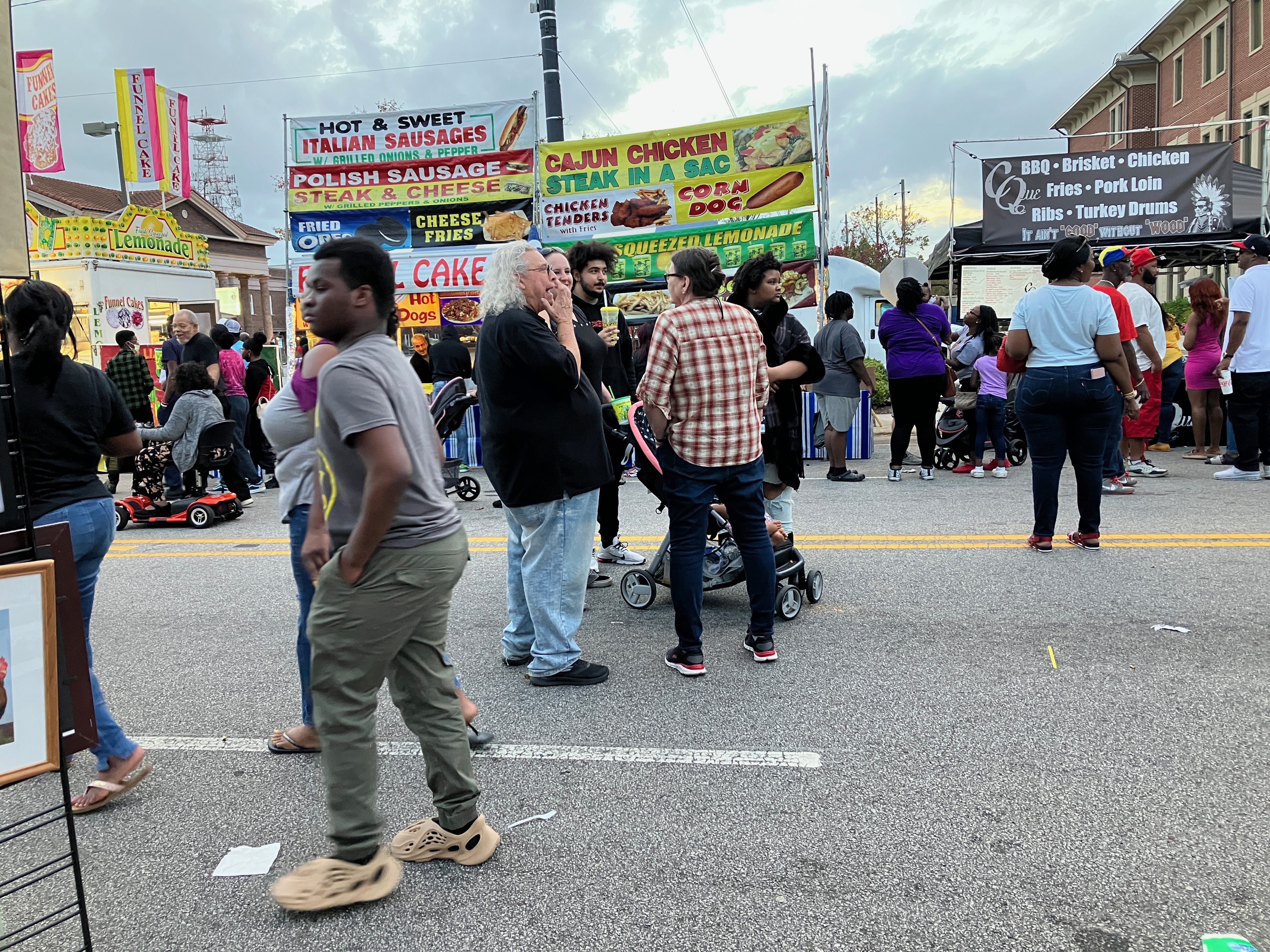
Pecan Festival, Florence, SC


Tent is set up, ready for the crowd
TWO SCENES 


At the Pecan Festival yesterday.


SCENE #1

“It offends me,” said a young, well dressed black woman, when she discovered I had written an antebellum novel from a slave’s point of view. “How can you know what it feels like to be a slave?”


I said, “Have you ever been a slave? How do you know how it felt?”


“But my ancestors were slaves.”


I said, “What about this? Can I write a story from a man’s perspective, though I’m not a man? Or can a male author write about a woman’s life?”


“That’s a different thing. Where do you get background information? How do you know what slaves suffered?”


“I used the slave narratives, many of them available at the Library of Congress.”


“What’s the slave narratives?”


I told her about the many interviews of former slaves that were recorded in the 1930s as a Writers Project when FDR was president. Within these interviews are many poignant and heart-breaking stories.


The well dressed young woman walked away, apparently still offended. 

The scene in front of my tent, a slow time
 

SCENE #2

Another black lady, who said she was born in 1938 but hardly looked her age, became engrossed in a small book about slavery that I put together using Macintosh Word and a stapler. The text came from the LOC narratives and photos from my collection from the internet.


We went through every one of the 30 pages, and I explained to her what I understood from the photographs. At the end, she said she was glad things weren’t now as they were then.


She suggested I publish and sell the book, and maybe I will. She thanked me for writing it. 


Doug, my partner and business manager


Saturday, October 15, 2022

Author Presentation, Moncks Corner, SC


Been brushing up on “Death & Dying, Antebellum Rituals” for a presentation Tuesday night at the Four Seasons History Club in Moncks Corner. I’ve spent time rummaging through books and the internet and finding more information…there’s always more information. To try to completely cover the subject would take days.


I’ve rearranged some of the sections, removed some information, such as info about medical care in the 19th Century. Treatments were based on a theory as old as ancient Greece, i.e., that illness was caused by in imbalance in the four humors (blood, phlegm, black and yellow bile).


Students at 19th Century medical schools generally learned by textbooks only. You could practically buy a degree, they were mostly diploma mills. No medical license was required even in the 1870s.


Anyway, I try to keep focused on “Death & Dying,” an apt subject with Halloween around the corner.


A slave funeral was different from an owner's


Thursday, March 29, 2018

Open Book Whitehead


COLSON WHITEHEAD


at University of South Carolina 

What a treat! Thursday evening Colson Whitehead appeared at the University of South Carolina and talked about his novel The Underground Railroad, which has won numerous awards including the Pulitzer Prize.

His sense of humor despite the grim subject of his book made for a lively presentation. Though his novel paints a dire picture of American slavery in the 19th Century, his talk was virtually apolitical. It was as if he said what he needed to say in his novel.
He is planning other writing projects and mentioned that he’d like to try his hand at different genres. I attended the presentation with my friend Carole Rothstein (below).
Carole and Whitehead, signing his book.
This is the first of a four-week series of author appearances at the University as part of The OpenBook. Discussions of the authors on Mondays precede the visits on Wednesdays (6-7:00 PM). Next Wednesday (April 4) Christina Garcia will discuss her novel King of Cuba.   

I still haven't finished The Underground Railroad, so there's not much of a chance I'll read Garcia's novel before next Wednesday. It's a challenge to try to read four books in four weeks. Fortunately, The Open Book is forgiving—no spotlights, no questions, no tests, just a great way to spend an hour. 


Sunday, July 23, 2017

Death & Burial at Batesburg-Leesville


BURIAL CUSTOMS 2

My next Presentation:

Death and Burial Customs in the Antebellum South
Monday, July 24, 2017
Time: 6 - 7:00 PM 

Location: Batesburg-Leesville Library
203 Armory Street, Batesburg, SC 29006
Ph: 803.532-9223
Admission: Free

I hope to see you there!

Sunday, July 31, 2016

Columbia II Blog


SC WRITERS ASSOCIATION GUEST BLOG

My blog, “A Road Paved With Good Intentions,” is featured on the Columbia II Writers Workshop blog this week. In it, I describe my experience writing the novel Kedzie, Saint Helena Island Slave. Though I didn’t know it at the time, my being a white author of a slave story made me politically incorrect. Antebellum fiction, whether it be novels or movies, resurrects old wounds and creates new ones. If you have your heart set on writing fiction that deals with our history of slavery, be prepared for a controversy. 

Sunday, July 17, 2016

The Help


WHITE AUTHORS of BLACK CHARACTERS

In the course of our book club evening Thursday, Carla Damron mentioned an associate who was interested in or had written Southern fiction. Since the black community’s push-back following the publication of The Help by white author Karthryn Stockett, Damron noted that white authors taking on black characters won’t be published today.

I can add my experience to that observation. When I was searching for an agent for my slave novel Kedzie, I had two interviews with literary agents at a conference of the SC Writers Workshop held at Myrtle Beach, SC. One agent, can’t remember the names, said she “couldn’t sell it in New York” because I’m white. This was a revelation to me. I had no idea I had stumbled into being politically incorrect. During the same weekend, a second agent, in answer to my question about the manuscript and my race, hesitated before she said it could be sold “if it’s good enough.” Her hesitation and manner said more than her words.

It was not long thereafter that I realized my novel had about as much chance of being published in the USA as a reporter’s exposé of corruption in the Kremlin had in Russia. I self-published Kedzie, Saint Helena Island Slave in 2011.

Whether or not The Help “distorts, ignores, and trivializes the experiences of black domestic workers” as claimed by the Association of Black Women Historians, their reaction has had far reaching influence on the publishing industry. That it discourages whites from attempting a black perspective is an unintended consequence, I hope.


Tuesday, April 5, 2016

Cayce Arts


Cayce Festival of the Arts

Coming this Saturday, April 9th at 1300 State Street with artists, crafters, and authors. I’ll be there with my friend and fellow writer Mike Long, author of a series of Western novels. 
 
McKendree (Mike) Long
Starts at 9:00 a.m. and ends at 5:00 p.m. Last year’s inaugural festival drew 2500 visitors and was a success for the Cayce Avenues Association. They’re predicting another good year. Along with tents displaying arts and crafts will be food vendors.

If you’re in the area, come by and say “hello.” And take a look at my historical fiction novels, all discounted from amazon prices. They include a series of four antebellum novels and a family saga:
— Kedzie, Saint Helena Island Slave, A brave girl foils the tactics of her owner
— Master of Westfall Plantation, A "good" plantation owner mistreats his family and slaves
— Cold Slave Cradle, A mute slave loves an orphan baby
— Westfall, Slave to King Cotton, Things fall apart with approaching secession
— Dust On the Bible - Twelve year-old Lily encounters a family secret
Along with meeting local writers, you’ll see artwork such as paintings, photography, jewelry, sculpture, wood carvings, and pottery. The Festival is located on the grounds of Brookland-Cayce High School, just a couple of turns off Knox Abbot Drive. I hope to see you there.

SPRING BREAK
My three grandsons spent last week with me and my husband Doug. From dawn till dusk we wore out the days. We took the boys fishing. Everybody, even the three year-old, caught a bluegill.

Doug and our son cleaned the fish. I pan-fried them for a fish supper.


We took advantage of a brisk wind Saturday afternoon to fly kites.


The tire swing was popular, 
though the limb of the pecan tree 
swayed enough to be a worry.


We painted dinosaurs, hunted for hidden treasure, made paper crowns, and planted beans and corn to begin the vegetable garden. In between times, the boys played on the play set Doug built. What a week! (I'm recovering.)


Tuesday, February 23, 2016

book fair & writers' conference


BOOK 'EM NORTH CAROLINA
Robeson Community College, Lumberton, North Carolina
February 27, 9:30 AM - 4:30 PM

I’m heading to Book 'Em North Carolina Friday for the writers conference and book fair which takes place Saturday. It's held in Lumberton at Robeson Community College (on Fayetteville road at Exit 22 of I-95) and entry is free.  

Last year I dressed in period clothes to set the scene for my antebellum novels.
This is my second year of attending, and I hope it's as enjoyable as last year. I'll be in the auditorium with other authors and publishers with a table to display my books—a series of four antebellum novels and my most recent book Dust On the Bible.

I'm looking forward to participating in a panel discussion on Historical Fiction at 10:00 AM Saturday morning in the Green Room. My friend and fellow writer Mike Long is also on the panel. Research is essential to this genre. While working on my antebellum novels, I read diaries, news reports, and slave narratives for background in order to describe the setting.

ANACHRONISMS = CARELESS WRITING
To avoid slipping up on an anachronism, I often went to Wikipedia and other online sources to research the origins of things, such as umbrellas or toothbrushes. Even at that, sometimes there were no clear answers to questions that came up while writing.

Sometimes research showed a date when a particular item first made its appearance, but that didn’t necessarily mean it was common to the time my novel was taking place. Franklin had invented the iron pot stove years before 1850, but the only references I saw to them were oblique. It would have been a rare plantation that used a pot belly stove for heat instead of a fireplace.

If you’re in the Lumberton area, I hope you’ll stop by Book ‘em North Carolina. It’s a great place to meet writers, authors, and other readers. 

I benefited from talking to other writers about what they were working on.

Wednesday, September 23, 2015

Lowcountry Festival


OCTOBER LITERARY FESTIVAL

I've recently updated my website with news of the upcoming Lowcountry Arts and Literary Festival on Saturday, October 24. I'll be there with my antebellum books, which are tailor-made for the Festival's location on Frampton Plantation at Yemassee, SC. The current big house, which dates back to 1868, replaces the one General Sherman's troops burned.

Frampton Plantation, Yemassee, SC

The Festival takes place on the plantation grounds under grand old oaks. In the back yard, you can see Civil War earthworks that General Lee's Army erected to defend the Confederate RR supply line between Savannah and Charleston. 

The building has been renovated to add electricity and plumbing and now houses the Lowcountry Visitor's Center as well as the local tourism commission. 

It promises to be a day of immersion in our history. Because many of us have mixed feelings about our Confederate past, we don't celebrate it. However, as a way of recognizing the courage of slaves and the inhumane system of law our state once upheld, we preserve the memory of that time. Beautiful old Lowcountry houses, such as the one at Frampton Plantation, are testaments to the skillful handiwork of slaves and freed blacks.

You can bookend the Lowcountry Arts & Literary Festival with the Beaufort Fall Festival of Houses and Gardens, which takes place the same weekend. It's a three-day event beginning on Friday evening and ending Sunday midday. I'm planning to wrap up the weekend at the Sunday Kitchens & Cuisine tour (five chefs at five houses). Beaufort is a short drive from Yemassee, maybe 20 minutes.

Till Next Time
A copy of the literary journal Kestrel containing my short story "Till Next Time" came in the mail. I'm pleased to see my work included with the outstanding quality of stories and poems that appear in this issue (Number 34). A copy of Kestrel is $15 and available from the Department of Language & Literature, Fairmont State University, Fairmont, WV 26554.

Wednesday, August 5, 2015

Prep for Red Piano Too


TOOLS TO TAKE US BACK IN TIME

Yesterday at the Old Mill Antique Mall is West Columbia (SC), I looked for relics of bygone times, especially those of rural America. At Red Piano Too's Art Show Saturday (August 8), I'll have a table to display my four antebellum novels. Mementos add interest, and that was what I was after. Found this miniature wagon (below), actually labeled a railroad car.

I filled the wagon with copies of my novel MASTER of Westfall Plantation, which is on the list of Best Books of 2015 by goodreads/BlueInk. I plan to have this as part of my display.

I also bought a singletree, which is part of a harness used with draft horses (horses used to plow or pull loads). It equalizes the load for the horse so that one side doesn't produce more drag than the other. Though you can't see it well in the photo, there are two hooks on each end of the singletree where lines are attached to each side of a horse's collar. The hook in the center connects lines from the singletree to the plow (or other load). 

  singletree
Maybe I'll have room on my table for the maul and butter mold I bought, examples of early tools made of wood. 
maul on left, butter mold on right
Or a hand scythe, an example of an implement forged in iron by blacksmiths and used to cut grain or grass. 
hand scythe
I'm looking forward to being on St. Helena Island with Mary Mack and Red Piano Too's artists.  If you're interested in the Gullah culture, it'll be in full array. Hope to see you there!


Monday, August 3, 2015

Update


REVISING AGAIN, WILL IT EVER END?
 
I'm slugging through another revision of my sequel to "Dust on the Bible." I thought it was polished and ready for my Editor (Steven Bauer), but after a week at the beach and away from the manuscript, I returned only to realize it's still wordy. I'm at the point of wondering if it will ever be finished (same point I've reached with every book). I'm trying not get totally sick of working on it. There will be more editing after Steven finishes with it. What I hope he doesn't suggest is something like a concept change.

You may have received one of my emails thanking those who voted and reminding others to vote for MASTER of Westfall, on the Goodreads/BlueInk list of Best Books of 2015. It's moved up the list from near the bottom to Number 3 (yeah!).
 

I'm thinking ahead to Saturday when I'll be at Red Piano Too's Art Show at St. Helena Island. Until my printer ran out of ink (new printer and have to order ink online, which I didn't realize), I was printing antebellum photos to display with my plantation novels Saturday. I hope to have a notebook of photos such as the ones below from the Library of Congress.

Tonight I'm going to Columbia II Writers Workshop. It meets the first and third Mondays of the month. It's a group of serious writers, many of them with published books.


Tuesday, June 23, 2015

n-word


N-word in the News Again

It’s a strange thing that you can’t say the word nigger in order to condemn its connotation without getting hit with headlines. Even President Obama can’t. The reaction to that word, regardless of its context, is provocative and electrifying.

No good use for it
We know this word causes pain for blacks. It is racially divisive. For many whites it arouses feelings of guilt about our history, particularly in the South. Anybody using that word in conversation today is saying more about himself that about any African American.

It terrifies publishers
NewSouth Publishing reprinted Mark Twain’s Adventures of Huckleberry Finn and removed the word nigger so black children won’t feel demeaned by reading it. Presumably NewSouth believes it will improve the lives of African Americans if we eradicate that word not only from our contemporary vocabulary, but from history as well.

There are those who would follow NewSouth’s lead and remove the word from print—take it out of antebellum novels, historic newspapers and magazines, the slave narratives, and antiquarian books. 

Easy Reading
The history of our country, especially the South, is easier to read when we don’t have nigger to remind us that some of us suffered atrocities in slavery and some of us tyrannized our fellowman. At the same time, getting rid of the word will do away with some of the ridicule and scorn whites inflicted and slaves endured in the 19th Century.

Our history is popular reading for many Americans. We can enjoy it more and we can like ourselves better when we have a history we can admire. Is this the kind of history we need?
Photo courtesy of the Library of Congress
An inflammatory history produces inflammatory words
Photo Courtesy of the Library of Congress

Wednesday, February 18, 2015

Revised Website


WWW.BONNIESTANARD.COM

I’m pretty proud of myself! Even if I can’t understand an idiot’s guide to web design, I revised my webpage myself—well, myself and godaddy. Only occasionally did godaddy freeze up on me, an accomplishment for a person who’s taken a while to learn how to forward and reply. That’s not to say my husband hasn’t had to put up with a few screams of “I can’t get this to work!” 

There are web design programs other than godaddy that amateurs such as myself can learn to use. What appears as one of the most common (perhaps because the company's name appears in the domain name) is WordPress, which will also handle registering your domain name. Another user-friendly web design tool that does the same is Posterous. See a link to a WordPress review below.* 


NEW PAGES
I’ve given each of my novels a page with an introduction since they are such close kin some people might confuse them. KEDZIE, Saint Helena Island Slave is the first one I wrote, but it shares a bed with SONNY, Cold Slave Cradle. And if they’re bedfellows, you might say MASTER of Westfall Plantation is a close but aloof sibling. Those three books segue into WESTFALL, Slave to King Cotton, which can be thought of as a family reunion. 

ANTEBELLUM
During the years 1857 through 1861 on a barrier island off the coast of South Carolina, no schooners dropped anchor. The stagecoach line ended twenty-five miles away. The ferryboat went to the mainland on high tide and returned on low tide. A packet-boat arrived ever so often with the mail, all of which was delivered to the general store. Everybody’s lineage was known and honored or dishonored, as the case might be. Nobody went unrecognized. Here was where mosquitoes bit and fevers raged. This setting was fertile ground for plots to take root. I’ve added a page to set the antebellum scene.


STUFF 
Also new to bonniestanard.com is a page titled “Stuff” where you’ll get a chance to win a copy of KEDZIE if you can figure out the name of a prominent 19th Century SC senator and proponent of slavery. (He was also US vice president under John Qunicy Adams and Andrew Jackson.) On the same page is a photo of a tree that’s located near Lyndon Johnson’s gravesite. I took it several years ago while in Texas. 

REVISIONS 
With all the changes I made, this photo, one of my favorites, didn't find a place. 

NEW INFO, NOT NEW PAGES
It is well past time that I put something besides a photo on the “Poetry” page. The new photo is of the beach, which introduces my poem “On the Ocean’s Edge.” The other poem is about my childhood. Both “Author” and “Other Work” pages remain with updated text and several new photos.


I hope you’ll take a look at the changes: bonniestanard.com. 

WordPress review at 
http://www.pcmag.com/article2/0,2817,2089365,00.asp


Friday, February 13, 2015

Fact re Historical Fiction


REALITY IN FICTION

The Westfall Novels

If you’re a writer of historical fiction, you know the importance of getting the details right. Too many mistakes brings into question your “reality,” and you risk losing not only readers, but your credibility as a writer. This subject will be discussed by a panel (“The History Behind Fiction”) at the Book ‘Em North Carolina festival in Lumberton on February 28.

I hope the inaccuracies in the antebellum novels I’ve written are small, innocuous ones. With good reason, I didn’t write the following sentences. Can you figure out what’s historically wrong?

-A boy threw a pebble and broke the kitchen window, a nuisance that sent the overseer to the village for a new one.
-The slave slipped into his master’s office and stole an ink pen and wristwatch.
-They took their son to the doctor, who gave him mercury pills for his fever.
-She was so nervous she sneaked into the piano parlor and lit a cigarette.
*See below for explanation.

SANDWICHES, MATCHES, STEEL
Sometimes you’ll find conflicting information. The word sandwich originated in the 18th century, but you won’t see references to them in 19th century diaries, magazines, or recipe books. I had a heck of a time figuring out how people started fires. Matches existed in Europe, but they were hard to come by in antebellum literature. After much research, I reached the conclusion that matches were making their appearance, but they were an early, and more volatile, version. I’ve seen in other antebellum novels references to steel. Until the Bessemer Process in 1855, steel was so difficult to produce it was rare in everyday life.

DIGGING FOR ANSWERS
The answers to many questions are found on Wikipedia, which I have used extensively. Books written during the 1850s, diaries in particular, were reliable sources. However, in general, slaves didn’t read or write, for it was prohibited by law. Most of the information I gathered about slaves came from the Slave Narratives, stories gleaned from former slaves by writers employed by the Federal Government in 1937-38. These narratives are available at the Library of Congress and are not only informative but interesting.


* Though glass jars were used, glass for windows was imported from England.
-Ink pens and wristwatches as such didn’t exist. More common were the quill and ink pot and pocket watches.
-Sick people didn’t go to the doctor. He came to them. Mercury pills were used to treat syphilis. 
-Cigarettes didn’t exist. Cigars did, and if a person lit one, he usually did it from a fire in the fireplace.