Showing posts with label attitude. Show all posts

Monday, July 6, 2026

Never enough


WANT WORM 

Today, after reading in A Sense of the Mysterious, it seems like I’ve been shortchanged. With so much intelligence in the world, why don’t I have more? For that matter, why don’t I have more physical ability? More creative resources?

I resent that I have been slighted. Is this niggling longing to be more intelligent, more physically capable, more creative wrong? Is this arrogance?

Is this an evil aspect of my nature? That enough is not enough. That limitations are too many.

The tug is toward dislike for myself. As if there are no things to like. I seem to turn a blind eye to what’s good in life, my life.

Is my aggrieved attitude a sign of narcissism? Who am I to question my place in the world?  I don’t want to be a person who doesn’t appreciate my life.  


Friday, March 13, 2026

A.I. writing test


The hand of the future?


 AI vs Human Writing

In this article, you’re given five samples, each with two texts (one A.I and one human). The subjects are 1) Literary Fiction, 2) Fantasy, 3) Science Writing, 4) Historical Fiction, and 5) Poetry. The human samples are from well known writers, such as Carl Sagan and Cormac McCarthy. After you read two excerpts, you select the one you like best. In every case, I chose the A.I. excerpt.

In these particular examples, A.I. passages evoke more human experience with greater subtly than actual human writing. Being a cynic, I suspect the passages were carefully selected because of their explicit messages, but even at that, we writers need to forget about denial as a defense. We’re not going to out-write A.I. The solution is somewhere else.

If it’s any comfort, we can tell ourselves that A.I would be nowhere without us. We control the choices, so far.


NEW YORK TIMES link: https://www.nytimes.com/interactive/2026/03/09/business/ai-writing-quiz.html?ae=oa&campaign_id=9&emc=edit_nn_20260311&instance_id=172326&nl=the-morning&regi_id=227682554&resp=1&segment_id=216486&user_id=3e762e87559516d79141d72aacf418b9

A,I. is stealing our brain with our permission


Saturday, December 27, 2025

Words vs Numbers

 A LOOK AT WORDS AND NUMBERS

I suppose most writers are fascinated by words, as I am. Recently in a poem I wrote, I take the position that everything that exists  (whether physical, mental, emotional) has a word. In essence, you can’t think of something (much less write about it) if there’s no word for it. My hope is that readers will realize this premise is questionable. And as an aside, is it possible that language limits our imagination?

IS THERE A DIFFERENCE?

We communicate not just with words, but with numbers. I’ve told my sons to think of numbers as a different language. Some people hold that we developed numbers just as we developed words in a language. There are other people who will argue that there’s a difference. Numbers are not invented, they’re discovered.

ALL THINGS ARE NUMBER

So said Pythagoras. That is to say, the physical world, everything you can see, smell, taste, feel, or think is quantifiable. And with the discovery, or maybe it’s the invention, of calculus, even relationships and movement can be communicated with numbers.

UNIVERSALITY OF NUMBERS

Now that I’m into numbers over my head, I’ll back out by saying that math was my worst subject in school. Nonetheless, our fascination with numbers and our dependence on them has never been greater. Seems we’re on our way to proving Pythagoras correct.

DATA ADDICTS

For the entertainment of mathematicaphiles, The Week magazine provides a column titled “The Bottom Line.” The shear amount of data collection and analysis is mind-boggling. Numbers relay meanings and can affect our opinions, maybe even change our mind. Several random samples from The Week:

25% of unemployed persons are age 25 and over

64% of Spotify’s most popular podcasts in 2024 were men

The average commuter spends a record 63 hours a year stuck in traffic

Consumers plan to spend an average of $890/person on holiday gifts, food, etc. 

 A book titled Book of Unusual Knowledge, a Christmas gift, states that it took about 30 million hours for Stone Age workers to build Stonehenge. Who figured that out and how?


SCIENTIFIC EVIDENCE?

Now I’m getting around to another point.  More and more research and/or scientific findings depend on data collection and not infrequently on polls taken of participants.

ARE THESE FACTS OR DATA DRIBBLE?

From The Times (UK) researchers analyzed data from 86,00 adults across 27 countries to find that learning a second language may help slow aging. (As if the only variable in 86,000 people is the number of languages they speak.)

Ultra-processed foods made up 55% of the food Americans ate from 2021 to 2023 according to the Centers for Disease Control. (What’s the definition of ultra-processed food?)

Researchers at the Univ. of British Columbia discovered that people are happier doing activities when sharing with others. Some 41,000 participants were quizzed on how happy they were doing three activities. (How happy? How reliable is a person’s opinion of their own happiness? And what if they’re asked on a bad day?)


Tuesday, July 29, 2025

Failing To Yield


OPEN TO DOUBT

My poem, “Failing To Yield,” has been published in the Spring/Summer issue of Quartet Journal. In an oblique way, the poem questions the value of prayer. When I was younger, I expected that by prayer I could reach God, who would intervene in an emergency and change things for the better, especially when difficulties seemed too hard to bear. For example, when my mom had a stroke, I prayed that she get better. When that didn’t happen, my lack of faith was at fault, at least that is what I was taught.

I have friends who, when they’re sick or have something like cancer, ask me to pray for them. I have to wonder what they expect of my prayers. And I wonder what I expect of those prayers.

Of course, prayers are of no use in saving lives or relieving pain, at least not physical pain. A prayer only has an effect, if at all, to the person who is praying. I pray for spiritual guidance, which I hope will give me good judgment and courage, but so far my prayers haven’t given me confidence in myself or God.


Every dead person is the same


WHAT MAY OR MAY NOT BE TRUE


I write poetry. I don’t necessarily write what I think is truth—or untruth for that matter. Thinking, for me, is neither true nor false. Really, isn’t it? Well, my thoughts can go a long distance without a label as to true or false.  

What’s real and what’s not real is a question I do think about. By that I mean real/unreal in a physical sense, not metaphysical (I’m dodging the argument that philosophy’s vocabulary deals with reality). Anyway, I’m sitting at my desk writing on my computer. That’s real, or at least I think it is.


Sometimes it’s not easy to separate physical from metaphysical lines in poetry. The murky, out-of-focus terrain between physical and metaphysical is one of the reasons I read poetry. Those lines throw a wrench into the brainworks. 


In writing poems, I want to make assertions that you can’t prove or disprove. For example, the last line of my poem “Lunch in a Belgian Chateau,” published in Last Stanza Poetry journal is “Every dead person is the same.” I can’t prove every dead person’s the same, but you can’t disprove it. I have a dear friend who would challenge me on this, but religious faith in an afterlife doesn’t rate as proof. 

Wednesday, April 23, 2025

Why Am I Here?

A book of ideas on thinking 

Why Am I Here?

If you’ve asked yourself this question in a strange room after a night of heavy drinking, that’s not what I’m about. If you’ve asked it while wondering if you should try to develop a relationship with a church or synagogue, you’re the person I’m talking to.


If you’re like me, you have difficulty buying the Christianity message, and Judaism seems to be a religion with no benefits, except maybe cultural. You can’t escape having a belief whether or not you put any thought into it. I know some people who seem to believe that the meaning of life is a good hamburger.


NO ANSWERS


Some of us can’t accept the meaning of life even if we don’t know the meaning. Or perhaps, we can’t accept that we can’t discover a meaning. Not even hamburgers.


Of course, philosophers can explain it, but when’s the last time you tried reading a book by John Locke or Immanuel Kant? Even when written in English, their words are unrecognizable, like a foreign language. Or if Socrates, the writing is so dense your thoughts implode.


On the other hand are philosophers who advocate meditation by which you can explore the self and existence. Maybe something’s wrong with me, but the only thing I get out of meditation is frustration. Wondering how much longer I can try to get my brain into a meaningful clarity has only led to boredom. 


GIVING UP THE QUESTIONS


In the book At the Intersection of Existence, author Davis Stanard asks himself questions about existence. Why Am I Here? Davis suggests we get over that and build a belief system that allows us to live a meaningful life, whatever is out there beyond life. He doesn’t provide answers but he gives himself, and by implication the reader, permission to quit asking unanswerable questions.


At the Intersection of Existence Back Cover

Friday, January 10, 2025

How To Spell Cat


My cat Millie

What’s not to like about a cat?


They rid your house of mice. They rarely if ever talk out loud or start fights. They warm your easy chair; poop in their potty; and don’t need your attention, though they tolerate it unless they’re in a bad mood. A cat is a good companion just to prove to you that you need one.


I once had a cat named Millie (Ironically after Millie came a granddaughter named Milla, short for Camilla).


Millie was in the kennel so often she started to think of it as home. We came to realize our travel schedule wasn’t fair to her and gave her to an employee at the kennel.


Perhaps people who can’t love cats have trouble with mysteries. After all, you can’t understand everything, in particular a cat.


Why don’t cats come when called? Why won’t they go on walks with you? Why do they stare out the window and then refuse to go outside? Why? Why?


I wrote a poem titled “How To Spell Cat.” It’s being published in the next issue of Lost Pilots. But don’t expect any hints about understanding cat behavior.

Link to Lost Pilots: https://lostpilotslit.com/


Monday, June 17, 2024

Two Enduring Movies

 MY LIFE AS A DOG


“My Life as a Dog” just became one of my favorite movies. Since Doug hadn’t seen it, I couldn’t wait to watch it a second time with him for a double-dose of enjoyment. It is currently streaming on Prime. 


My Life as a Dog is in the Criterion Collection

Doug was restless and could hardly make it to the concluding credits. What is to me a realistic movie that captures the strength and creativity of a youth in calamitous circumstances was to Doug a melancholy movie about a boy with no home. It made him sad.


“My Life as a Dog” inspired me and reminded me that genius filmmakers exist (or have existed), though you might not think so, given the usual pablum showing at Columbiana. This is a Swedish movie released in 1987. Some things never grow old.


Another movie about a boy that makes no notice of the passing of time is “Empire of the Sun,” as meaningful today as when it was made in 1984. It also has sadness, but this underscores a boy’s courage and endurance in the face of everyday disasters.


The spirit of these two protagonists is meaningful today. Rather than become victims of harrowing circumstances beyond their control, Ingemar (in My Life as a Dog) and Jamie (in Empire of the Sun) tackle the circumstances of their life as best they can and never lose hope.


Wednesday, May 8, 2024

red-faced ranting


Me, this morning
RANT ON PUBLISHERS

Sometimes you just have to rant to keep your sanity. My sanity has been put to the test by my publisher's questionnaire regarding the upcoming release of a fiction book. In the list of questions:


1) List any potential reviewers, publications, and media outlets that you can contact who might be willing to publish a review, article, or announcement about your book.


2) List libraries, booksellers, and other venues who may host a book event for you.


3) you’ll need to talk about your book to groups and individuals, market your book on your website, social networks, and by other methods.


PROVIDE YOUR OWN MARKETING

Maybe I’m overreacting, but my impression is that the publisher isn’t just asking for assistance in marketing my book, it’s asking me to do all the marketing. From my previous experience, none of my publishers called me regarding a possible appearance or a possible interview or book signing. Not once.


INDEPENDENT PUBLISHER DILEMMA

The publisher here is a small independent publisher, which is where any unknown writer has an outside chance of getting their book published. Though independent publishers may be struggling to survive in a commercial environment that is toxic, to cut costs by cutting marketing is self-defeating, not just for their authors but for their own financial well being.


DO I HAVE FANS?

Do publishers realize that first time authors don’t have fans? We don’t belong to a hundred organizations. We don’t hobnob with literati. We don’t host socials. We have no clout.


CLOUT IS THE ISSUE

Publishers have clout, if they choose to use it. Who is more likely to get a book signing scheduled at Barnes & Noble—me (an unknown person) or a publisher (even an unknown one)? The mere fact that a publisher makes the call provides legitimacy, one that no beginning author can muster regardless of how wonderful the book.


LONG TERM EFFECT

When publishers cut the marketing department from the budget, their bottom line will look good in the short term, but the long term consequences are dismal. Publishers can only thrive if their authors thrive. And emerging authors can only thrive with marketing support from publishers.


An even more disappointing consequence is that some of the most creative and talented writers do not have a chance to reach an audience (despite enthusiastic promises from the self-publishing sector). We’ll blaze no new literary trails given the current environment.


Saturday, February 10, 2024

3 poems accepted for publication

PROTESTING

I have never liked the word protester. It’s a relative to the word victim. In the balance of power, protesters are losers. Their weakness makes them squeal rather than fight. I say this knowing full well that many protesters would fight, given the right circumstances. But circumstances have a lot to do with whether we are strong or weak. Over time and without the means to fight, a protester can become a whiner. Having said that, the word serves a useful if not necessary purpose and expands our language.


So why am I protesting the word protester? It’s my weakness. One of the poems to be published later this month in the ezine Bloom is a protest. How’s that for shooting myself in the foot?


“Period of Uncertainty” is about the predicament of women with respect to pregnancy and birth control. This protest embodies the ultimate power struggle, one in which a woman is pitted against religious belief as well as her own physiology. It ends with these lines:


Who will speak of these things
with a tongue untainted by inheritance?


Monday, November 6, 2023

appropriation

 Cultural appropriation is censorship by another name


One of the sessions at the SC Writers Association’s conference Saturday allowed writers to read aloud their query letter to a panel of three literary agents for critique. I made a mistake. Because I hadn’t read the directions carefully, I arrived with a pitch instead of a query letter, which I read anyway despite my embarrassment.


However, I couldn’t have been as disappointed with my critique as another writer who actually read a query letter. Her book, the subject of the letter, involved a story with a slave.


The subject of “appropriation” dominated the agents’ comments. Appropriation in writing is commonly understood to mean that a writer adopts customs, behavior, habits, etc., of a culture that’s not their own in producing a book. For example a white writer produces a story about a black, or a Latino writes about an Asian.


The writer at the conference who read her query letter before the panel was cautioned that we have to be careful in today’s environment. By the time the agents finished their cautionary statements, it was clear that the writer’s book had no chance of being published. The problem was her color. She was white and her story involved a black slave.


When it comes to cultural appropriation, a distinction should be made between historical fiction and contemporary fiction. It is easier to understand that ethnic groups have a right to claim their story as it exists today. Who better to understand the traditions, language, and ideas than one of their own members?


But historical fiction is another matter. The most contentious issue today is that blacks claim ownership of their history as slaves. The argument goes that they were the ones who suffered and no white (or yellow or red) person can understand this. But how can a black person living in the 21st Century understand what their ancestors underwent over a hundred years ago?


A white writer has as much access to the Slave Narratives and slave autobiographies as a black writer. When you come to think of it, one of the most powerful books written about slavery was written by a white woman. Historians credit Uncle Tom’s Cabin by Harriet Beecher Stowe with galvanizing the abolition movement. Are we to say she had no right to write this book?


Restricting historical fiction novels to certain authors based on ethnicity limits our perspective, imagination, concepts and understandings. The losers here are not just whites but black, reds, and yellows, the entire spectrum of literature.


"Query Letter" panel of literary agents


Sunday, November 6, 2022

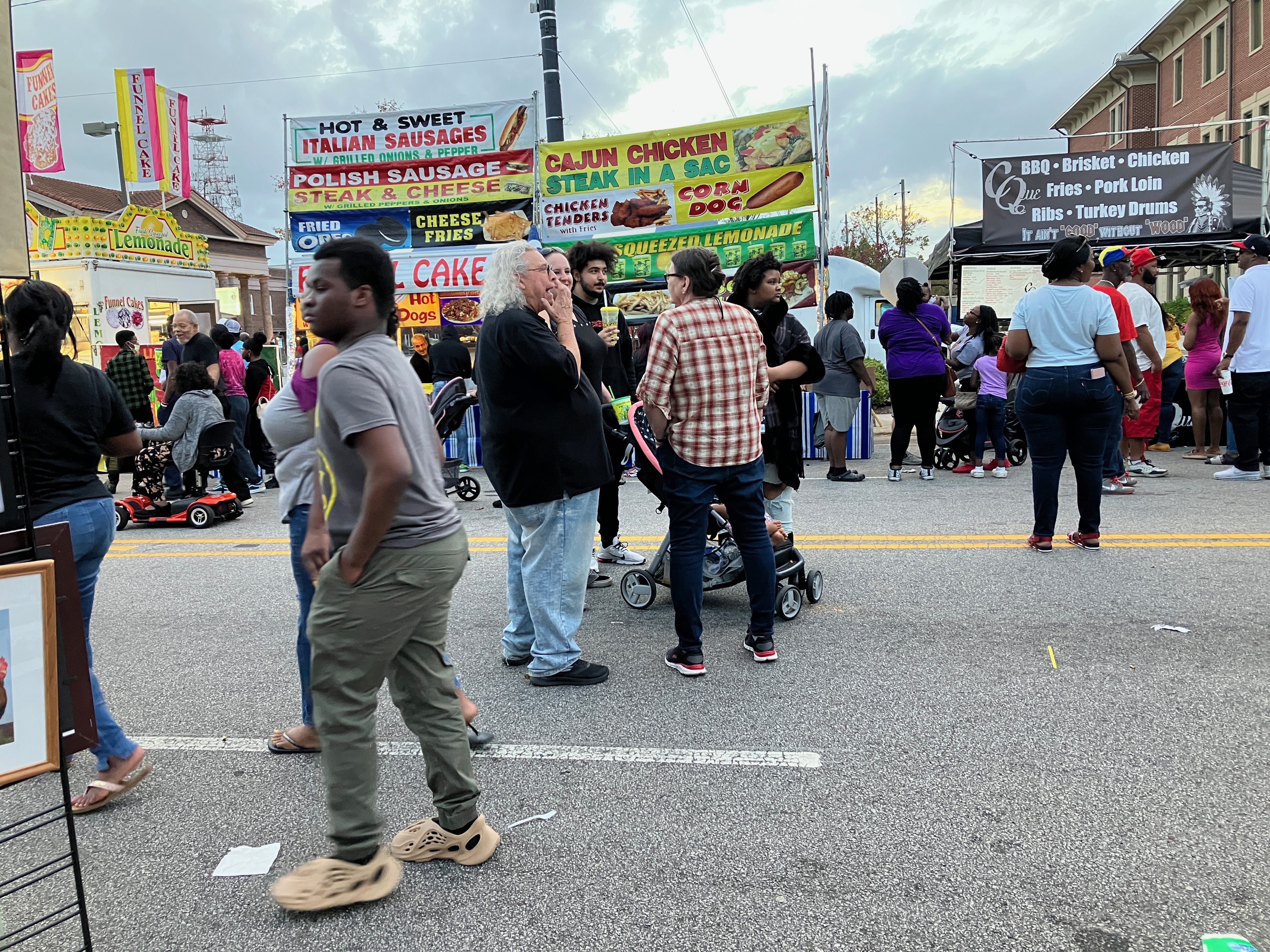
Pecan Festival, Florence, SC


Tent is set up, ready for the crowd
TWO SCENES 


At the Pecan Festival yesterday.


SCENE #1

“It offends me,” said a young, well dressed black woman, when she discovered I had written an antebellum novel from a slave’s point of view. “How can you know what it feels like to be a slave?”


I said, “Have you ever been a slave? How do you know how it felt?”


“But my ancestors were slaves.”


I said, “What about this? Can I write a story from a man’s perspective, though I’m not a man? Or can a male author write about a woman’s life?”


“That’s a different thing. Where do you get background information? How do you know what slaves suffered?”


“I used the slave narratives, many of them available at the Library of Congress.”


“What’s the slave narratives?”


I told her about the many interviews of former slaves that were recorded in the 1930s as a Writers Project when FDR was president. Within these interviews are many poignant and heart-breaking stories.


The well dressed young woman walked away, apparently still offended. 

The scene in front of my tent, a slow time
 

SCENE #2

Another black lady, who said she was born in 1938 but hardly looked her age, became engrossed in a small book about slavery that I put together using Macintosh Word and a stapler. The text came from the LOC narratives and photos from my collection from the internet.


We went through every one of the 30 pages, and I explained to her what I understood from the photographs. At the end, she said she was glad things weren’t now as they were then.


She suggested I publish and sell the book, and maybe I will. She thanked me for writing it. 


Doug, my partner and business manager


Wednesday, September 7, 2022

politically correct publishing


enforced virtue


“We will not tolerate any form of abusive behavior or bigotry in the stories we publish, nor the authors who write them.”


“If it should come to our attention that one of our writers has themselves published hateful material elsewhere, we want to know about it.”


According to Lit Mag News Roundup, two editors were forced off the masthead of literary magazines based on opinions they expressed online. Further, they’ve “seen numerous magazines announce the removal of writers’ work, based on things that writer has said on their personal page.”


Something to think about

The following authors were published before we became politically correct, but could they find a publisher today?


Rudyard Kipling

Instances of racial insensitivity and colonialist arrogance in his writings.


Roald Dahl

According to Dahl, the Jewish people deserved what they got during the Holocaust.


William Faulkner

Controversial portrayal of race and class.


Dr. Seuss

The Seuss estate stopped selling “Mulberry Street” because of the racial stereotype of an Asian man with slanted lines for eyes.


Charles Dickens

He publicly shamed his wife in writing, calling her mentally disturbed and malicious after she became aware of his mistress and they divorced. 


In our current publishing environment, will the books of these famous writers survive the controversy? Do we want to lose access to stories such as:


The Jungle Book 

Charlie and the Chocolate Factory 

As I Lay Dying

If I Ran the Zoo 

Oliver Twist

This is not meant to condone bigoted or hateful writing. But should the personality, beliefs, or behavior of a writer or artist keep us from experiencing the pleasure of superior work? The first, foremost, and only question should be, Can they write?


Thursday, June 16, 2022

Safety and travel


THE LONE TRAVELER


I have three questions this morning:

1) Should a person (my son) travel abroad alone?

2) And if they do, should they provide an itinerary to family?

3) Am I a worry-wort?


My adult son is traveling alone in a foreign country. I've asked for an itinerary of where he plans to stay and what he'll visit. The hints I'm getting from my husband is that the answer to #3 is "yes."


Ignorance can mean danger if not death. There's a sharp curve in the highway in front of my brother's house in Fairview where at least two accidents have occurred in the last several years, one of them with a fatality. My point is that drivers on the Wagener Highway, which is usually straight as an arrow, will encounter this curve suddenly, and if you don't know the road, you're a candidate for an accident. 


It's foolish to approach the unknown as if it is known, and a foreign country is unknown territory. Books on travel don't usually point out risky areas, gang territory, or antiAmerican neighborhoods.


THERE IS NO SURE LIFE. THERE IS SURE DEATH.

So if we want to be sure about anything, we can be sure that the day will come when we will die. Do we want increase our chances of dying?


We can do this in a number of ways:

—climb a mountain

—drive a car

—live on the south side of Chicago

—travel alone in Iran


My son is not in Iran, but a country that, by comparison, is "safe" for Americans. But is any lone traveler safe? Many things influence the odds affecting safety. Add one person as a companion and the safety meter improves.


DISAPPEARANCE

Years ago a businessman boarded a plane in Florida for a trip to Colombia and was never heard from again. Why do I remember this? My husband was traveling for business at the time. This was somebody's husband. Businesses keep track of their traveling managers for several reasons, not least of which is for safety.


PLAYIING THE ODDS

It's a matter of making favorable odds for yourself. A mountain climber equips himself, chooses weather and circumstances that affect his chances of survival. The way people drive influences those chances. So does where you live.


As I write this, my husband is traveling alone in Illinois. It is a comfort to me to have the name of his motel and his daily plans. We talk on the phone every day. However, international travel with multiple time zones makes phone calls problematic. Alone in Illinois is not the same as alone in Latvia.


AM I A WORRY-WART?

Years ago in the 1930s, a cousin of my father disappeared without explanation, and he wasn't in a foreign country, unless you consider the backwoods of South Carolina foreign (you can make the argument). The name Luico Gantt has become legendary in our family. There was a rumor he was in Washington, DC, and a cousin in the military tried to find him. Even today, I have a sense of loss for this relative I never knew.


Is it unreasonable for me to want to keep track of a family member? By asking my son for an itinerary am I a pessimist, assuming the worst?


Wednesday, February 23, 2022

Getting-together a presentation


SPELLBINDER FROM THE PODIUM


I'm working on a lunch presentation I'll make for the Shepherd's Center in Lexington on March 17. I'm not a natural when it comes to speaking publicly, so it takes preparation and a script.


Advice I've picked up:

Tell a joke every five minutes. I have embarrassed myself so many times trying to tell a joke. I'm like my mother, who became so tickled in the process that she was the only one laughing at the punch line. At least she could remember the punch line.


ChuckPalahniuk wrote in his book ConsiderThis that he threw treats into audiences. Thinking along those lines, I bought wrapped candies. Doug ate them, so yesterday I bought more and have hidden them in the laundry room. I haven't figured out if I can work this into my presentation, but as the day nears, I'll have candy to calm me down.


Use PowerPoint, exciting visuals. The problem with this scenario is my technophobia. My laptop is a challenge, though I pride myself on having prepared zoom presentations on Keynote as well built a website . And obviously I manage to post blogs. However, I shudder at the thought of taking my laptop out of the office.


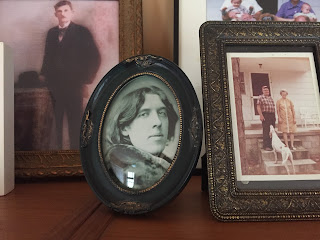
I love quotations. Oscar Wilde supposedly said, "Quotation is a serviceable substitute for wit." I don't think I'm witless, but sometimes I have my suspicions. I have a framed photo of Wilde in my office. His quotes cheer me up if I'm down.


The title of my presentation is taken from a quote by W. Somerset Maugham, "There are Three Rules of Writing." You have to know up front that anybody who suggests there are THREE rules must mistake himself for God. Maugham saved himself, and I'll save myself, with the completion of that quote, which is: "Unfortunately, no one knows what they are."


Oscar Wilde, between my grandfather (l.) and my parents (rt.)


Monday, July 19, 2021

Guest Blogger - Columbia Writers


FOR GOOD OR BAD


Do books have morals? Maybe it's easier to ask "Do movies have morals?" I'm suggesting that words and pictures that appear for public consumption are not just entertainment, but they have an effect on us. And by extension, on our culture.


Writers are encouraged to grab the reader in the first sentence and keep them in suspense for the duration of a novel. That's one reason we see fiction take off with a sex scene and continue with murder, fist fights, and drugs for 300 pages.


Some thoughts on this in my blog for the Columbia II chapter of the SC Writers Association.