Showing posts with label history and the South. Show all posts

Monday, August 11, 2025

The Right to Write

 SLAVERY in HISTORY 

Charleston, SC and slavery books 
 

Why am I not surprised to see the above headline? Maybe it’s because of my experience as the author of four historical fiction novels that tell the story of whites and slaves on a Southern plantation in 1857.


Before self-publishing, I queried a number of literary agents seeking a representative for my work. Two of them told me (a white woman) that they could not sell the manuscript in New York because there were slaves in the story. Maybe my books aren’t good books, but to have them rejected because of the subject matter doesn’t give me a chance, even if they’re excellent books. How has compassionate socialism turned into political correctness and worse, repression? 


Our media spurns Putin’s decision to rewrite Russian history, as if we aren’t doing the same thing. According to The Conversation, “New Russian high school textbooks … attempt to whitewash Stalinist crimes and rehabilitate the Soviet Union’s legacy.”


In particular, Russian history is being revised to “gloss over Stalin’s Terror and other truths.”

From the History News Network:
Now you see him, now you don’t. Stalin was a past master at the art of airbrushing. In one classic set of photographs, there Stalin is with his secret police chief, Nikolai Yezhov — and in the next photo, there Yezhov isn’t (he was executed in 1940, with his boss’s approval). And now, in Vladimir Putin’s Russia, the airbrushing of history seems to be all the rage again.

Are we Americans trying to airbrush our history of slavery? A fiction novel set in the antebellum South either conforms to certain social strictures or it doesn’t get published by legacy publishers, regardless of the merit of the writing. When our history is ugly, no good is served by suppressing it.


Monday, November 6, 2023

appropriation

 Cultural appropriation is censorship by another name


One of the sessions at the SC Writers Association’s conference Saturday allowed writers to read aloud their query letter to a panel of three literary agents for critique. I made a mistake. Because I hadn’t read the directions carefully, I arrived with a pitch instead of a query letter, which I read anyway despite my embarrassment.


However, I couldn’t have been as disappointed with my critique as another writer who actually read a query letter. Her book, the subject of the letter, involved a story with a slave.


The subject of “appropriation” dominated the agents’ comments. Appropriation in writing is commonly understood to mean that a writer adopts customs, behavior, habits, etc., of a culture that’s not their own in producing a book. For example a white writer produces a story about a black, or a Latino writes about an Asian.


The writer at the conference who read her query letter before the panel was cautioned that we have to be careful in today’s environment. By the time the agents finished their cautionary statements, it was clear that the writer’s book had no chance of being published. The problem was her color. She was white and her story involved a black slave.


When it comes to cultural appropriation, a distinction should be made between historical fiction and contemporary fiction. It is easier to understand that ethnic groups have a right to claim their story as it exists today. Who better to understand the traditions, language, and ideas than one of their own members?


But historical fiction is another matter. The most contentious issue today is that blacks claim ownership of their history as slaves. The argument goes that they were the ones who suffered and no white (or yellow or red) person can understand this. But how can a black person living in the 21st Century understand what their ancestors underwent over a hundred years ago?


A white writer has as much access to the Slave Narratives and slave autobiographies as a black writer. When you come to think of it, one of the most powerful books written about slavery was written by a white woman. Historians credit Uncle Tom’s Cabin by Harriet Beecher Stowe with galvanizing the abolition movement. Are we to say she had no right to write this book?


Restricting historical fiction novels to certain authors based on ethnicity limits our perspective, imagination, concepts and understandings. The losers here are not just whites but black, reds, and yellows, the entire spectrum of literature.


"Query Letter" panel of literary agents


Sunday, November 6, 2022

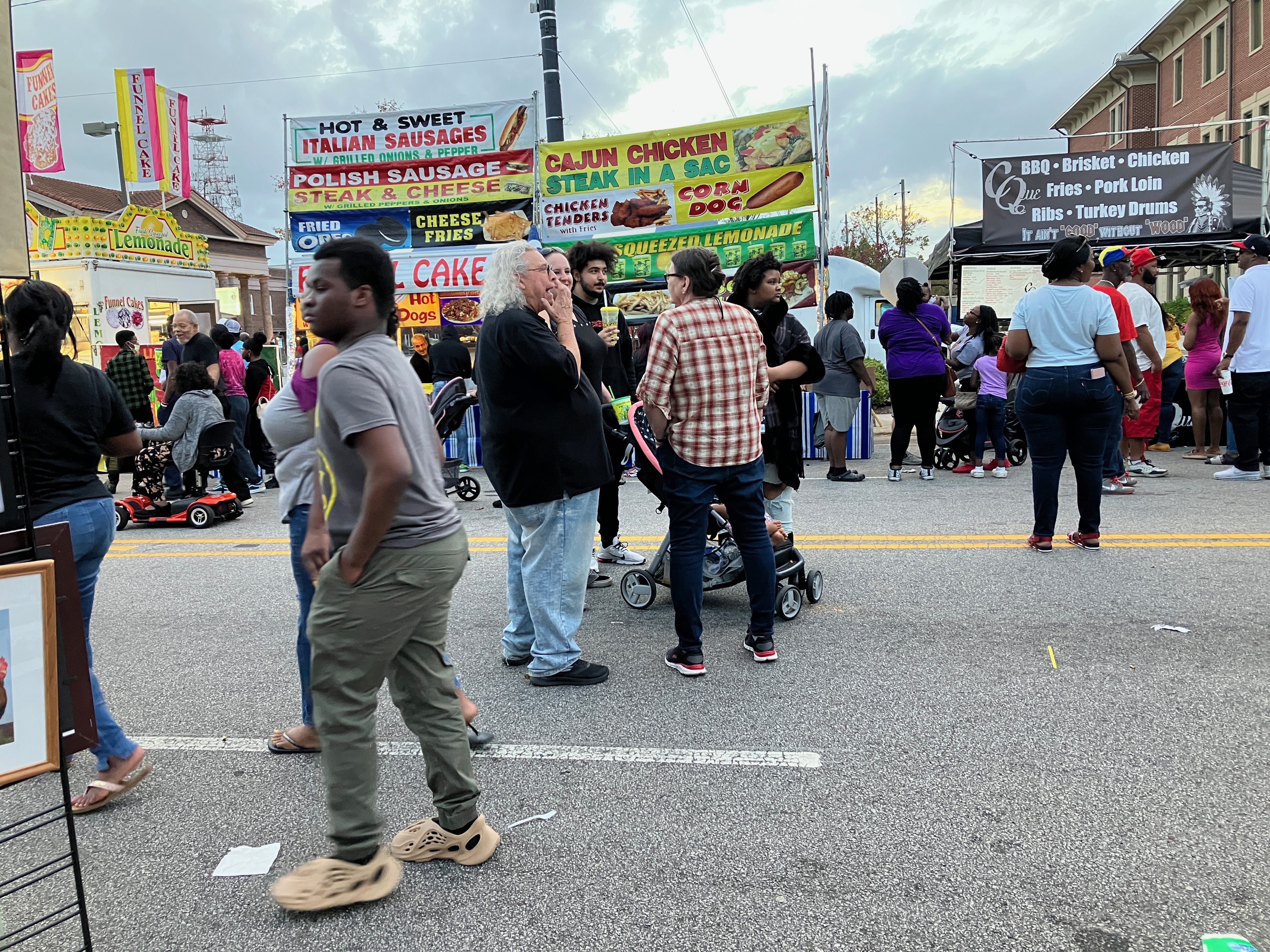
Pecan Festival, Florence, SC


Tent is set up, ready for the crowd
TWO SCENES 


At the Pecan Festival yesterday.


SCENE #1

“It offends me,” said a young, well dressed black woman, when she discovered I had written an antebellum novel from a slave’s point of view. “How can you know what it feels like to be a slave?”


I said, “Have you ever been a slave? How do you know how it felt?”


“But my ancestors were slaves.”


I said, “What about this? Can I write a story from a man’s perspective, though I’m not a man? Or can a male author write about a woman’s life?”


“That’s a different thing. Where do you get background information? How do you know what slaves suffered?”


“I used the slave narratives, many of them available at the Library of Congress.”


“What’s the slave narratives?”


I told her about the many interviews of former slaves that were recorded in the 1930s as a Writers Project when FDR was president. Within these interviews are many poignant and heart-breaking stories.


The well dressed young woman walked away, apparently still offended. 

The scene in front of my tent, a slow time
 

SCENE #2

Another black lady, who said she was born in 1938 but hardly looked her age, became engrossed in a small book about slavery that I put together using Macintosh Word and a stapler. The text came from the LOC narratives and photos from my collection from the internet.


We went through every one of the 30 pages, and I explained to her what I understood from the photographs. At the end, she said she was glad things weren’t now as they were then.


She suggested I publish and sell the book, and maybe I will. She thanked me for writing it. 


Doug, my partner and business manager


Saturday, October 15, 2022

Author Presentation, Moncks Corner, SC


Been brushing up on “Death & Dying, Antebellum Rituals” for a presentation Tuesday night at the Four Seasons History Club in Moncks Corner. I’ve spent time rummaging through books and the internet and finding more information…there’s always more information. To try to completely cover the subject would take days.


I’ve rearranged some of the sections, removed some information, such as info about medical care in the 19th Century. Treatments were based on a theory as old as ancient Greece, i.e., that illness was caused by in imbalance in the four humors (blood, phlegm, black and yellow bile).


Students at 19th Century medical schools generally learned by textbooks only. You could practically buy a degree, they were mostly diploma mills. No medical license was required even in the 1870s.


Anyway, I try to keep focused on “Death & Dying,” an apt subject with Halloween around the corner.


A slave funeral was different from an owner's


Wednesday, February 20, 2019

Pat McNeely Presentation


WORDS & WINE

Author Pat McNeely had the spotlight last night at Words & Wine hosted by the Lourie Center in Columbia. Many, if not most, of her nonfiction books focus on the history of South Carolina, with titles such as Eyewitnesses to General Sherman’s Campaign, and Lincoln, Sherman, Davis and the Lost Confederate Gold. Her other books touch on the media and recipes from an historic perspective.

Her presentation, “Andrew Jackson, John C. Calhoun, and the Petticoat Affair,” pointed out the many commonalities between Calhoun and Jackson. Though they had been friends, later in life they became fierce enemies.

SC author Patricia McNeely
Wish I had taken notes and could report some of the fascinating details McNeely brought out. However, I was too engrossed in the program. She delivered many interesting asides to the life of each of these historic figures.

Nobody left hungry, given the spread of cheeses, fruits, crackers, sausages and wine. And two of my favorite guitarists, Ken Baldwin and Igor Agafonov, turned the welcome into a party. Sponsors for the evening were Trader Joes and Rob Akers-Trevett.
Words & Wine hosts monthly events that feature local authors and musicians. Chris Maw does a great job of getting it together. Chris emails a calendar of the author presentations as well as other local events. If you're interested in being on her email list, the address is chrisemaw.2015@gmail.com.

Thursday, March 29, 2018

Open Book Whitehead


COLSON WHITEHEAD


at University of South Carolina 

What a treat! Thursday evening Colson Whitehead appeared at the University of South Carolina and talked about his novel The Underground Railroad, which has won numerous awards including the Pulitzer Prize.

His sense of humor despite the grim subject of his book made for a lively presentation. Though his novel paints a dire picture of American slavery in the 19th Century, his talk was virtually apolitical. It was as if he said what he needed to say in his novel.
He is planning other writing projects and mentioned that he’d like to try his hand at different genres. I attended the presentation with my friend Carole Rothstein (below).
Carole and Whitehead, signing his book.
This is the first of a four-week series of author appearances at the University as part of The OpenBook. Discussions of the authors on Mondays precede the visits on Wednesdays (6-7:00 PM). Next Wednesday (April 4) Christina Garcia will discuss her novel King of Cuba.   

I still haven't finished The Underground Railroad, so there's not much of a chance I'll read Garcia's novel before next Wednesday. It's a challenge to try to read four books in four weeks. Fortunately, The Open Book is forgiving—no spotlights, no questions, no tests, just a great way to spend an hour. 


Wednesday, July 26, 2017

Photos-B&L Library


PHOTOS – Batesburg-Leesville Library

I was pleased with the audience at the Batesburg-Leesville Library for my presentation of “Death & Burial” Monday night. As was true at Pelion, the faces that looked at me were attentive and respectful, rather like the subject we were discussing.
Lindy introduced my presentation.

This is where patients were often lanced for bloodletting treatment.


It's gratifying to meet others interested in our history.
My thanks to Lindy and the library staff for their friendly welcome. Also, thanks to Rachel Oglesby for inviting me. Photo credits with appreciation to my friend Carole Rothstein.


Sunday, July 23, 2017

Death & Burial at Batesburg-Leesville


BURIAL CUSTOMS 2

My next Presentation:

Death and Burial Customs in the Antebellum South
Monday, July 24, 2017
Time: 6 - 7:00 PM 

Location: Batesburg-Leesville Library
203 Armory Street, Batesburg, SC 29006
Ph: 803.532-9223
Admission: Free

I hope to see you there!

Thursday, July 20, 2017

Photos, Death and Burial at Pelion


PELION LIBRARY

Death and Burial Customs last Saturday morning.
I explain how to spot the deceased person in a group photo.
As you might expect, audience participation on the subject of death is restrained.
The lady with her back to us told of dolls created to look like lost babies.
Drawing for the door prize. Librarian Shirley Sprenne with me.

My thanks to Librarian Shirley Sprenne for making the arrangements and for her hospitality. Thanks to Douglas Stanard for taking photos. 


Friday, June 30, 2017

death & burial in the antebellum South

 
ANTEBELLUM DEATH
 Postmortem photography was a thriving business in the 19th Century

Times have changed. Doctors no longer bleed us with leeches nor prescribe poisonous “blue pills.” We don’t drape crape over the mirror when somebody dies. We don’t sit up all night in the living room with the body. We aren't confined to solitude for months following a death.

I’ll talk about “Death and Burial in the Antebellum South” at the Pelion Branch Library. I hope to see you there. Here’s the time and place
  • Saturday, July 15 at 10:00 AM
  • Pelion Library, 206 Pine Street, Pelion, SC
  • Free and open to the public
 This is a postmortem photo. Can you tell which of the two is deceased?


Sunday, July 31, 2016

Columbia II Blog


SC WRITERS ASSOCIATION GUEST BLOG

My blog, “A Road Paved With Good Intentions,” is featured on the Columbia II Writers Workshop blog this week. In it, I describe my experience writing the novel Kedzie, Saint Helena Island Slave. Though I didn’t know it at the time, my being a white author of a slave story made me politically incorrect. Antebellum fiction, whether it be novels or movies, resurrects old wounds and creates new ones. If you have your heart set on writing fiction that deals with our history of slavery, be prepared for a controversy. 

Wednesday, September 23, 2015

Lowcountry Festival


OCTOBER LITERARY FESTIVAL

I've recently updated my website with news of the upcoming Lowcountry Arts and Literary Festival on Saturday, October 24. I'll be there with my antebellum books, which are tailor-made for the Festival's location on Frampton Plantation at Yemassee, SC. The current big house, which dates back to 1868, replaces the one General Sherman's troops burned.

Frampton Plantation, Yemassee, SC

The Festival takes place on the plantation grounds under grand old oaks. In the back yard, you can see Civil War earthworks that General Lee's Army erected to defend the Confederate RR supply line between Savannah and Charleston. 

The building has been renovated to add electricity and plumbing and now houses the Lowcountry Visitor's Center as well as the local tourism commission. 

It promises to be a day of immersion in our history. Because many of us have mixed feelings about our Confederate past, we don't celebrate it. However, as a way of recognizing the courage of slaves and the inhumane system of law our state once upheld, we preserve the memory of that time. Beautiful old Lowcountry houses, such as the one at Frampton Plantation, are testaments to the skillful handiwork of slaves and freed blacks.

You can bookend the Lowcountry Arts & Literary Festival with the Beaufort Fall Festival of Houses and Gardens, which takes place the same weekend. It's a three-day event beginning on Friday evening and ending Sunday midday. I'm planning to wrap up the weekend at the Sunday Kitchens & Cuisine tour (five chefs at five houses). Beaufort is a short drive from Yemassee, maybe 20 minutes.

Till Next Time
A copy of the literary journal Kestrel containing my short story "Till Next Time" came in the mail. I'm pleased to see my work included with the outstanding quality of stories and poems that appear in this issue (Number 34). A copy of Kestrel is $15 and available from the Department of Language & Literature, Fairmont State University, Fairmont, WV 26554.

Monday, August 24, 2015

Gettysburg

CANNON LINED FIELDS

Gettysburg is a beautiful town. But the voices of the dead are everywhere. The Rebel yell. Charging horses. Exploding cannons. Musket fire. So fervent were the beliefs of the opposing sides that upon meeting here they slaughtered each other. In spite of the passage of time, death stays near the battlefield at Gettysburg, now littered with monuments and markers. As the passion that brought the armies here fades into memory, monuments to the North and the South stand side by side.


The cannon beside me is pointed toward Little Round Top 
where Union soldiers held off a Confederate assault. 
Below I'm standing with guide Ellen on top of Little Round Top. 
The location's panoramic view made it strategically important.


It's not easy, even with a well-informed guide, to follow the location of the armies and the progression of battles over the three days of intense fighting in July 1863. General Lee realized the battle was lost after the devastating loss of men in Pickett's charge. 

If you think you'll take a walking tour of the Gettysburg Battlefield, think again. We were in a car for over two hours and covered about 24 miles.


Today Gettysburg appears to be a thriving town. Historic homes and storefronts are well preserved. Pedestrians weave around one another on crowded sidewalks. At dinnertime, there was an hour wait at some restaurants. Students beginning at Gettysburg College were in town with their parents.

HARPERS FERRY

John Brown is a fascinating historical character. I'm not sure anybody has figured out whether he was a crooked opportunist or a hero. However, as we discover the flaws in our heroes, I'm coming to believe a person can be both crooked and heroic at the same time. 

The historic town of Harpers Ferry is located on a bluff overlooking the Shenandoah River. It's essentially a steep street lined with historic buildings in need of preservation. 

Behind me the Potomac and Shenandoah Rivers merge at Harpers Ferry.

APPOMATTOX

We stayed at the Babcock Bed and Breakfast, which I discovered is named after Havilah Babcock, a former English professor at the Univ. of South Carolina. In fact I took his last class of "I Want a Word" before he retired. I still have a copy of the book we used in class.

I'm leaving the Babcock B&B.

Appomattox Court House is actually the name of the town. And General Lee surrendered to General Grant not in the courthouse but in the nearby farm house of Wilmer McLean. The building on tour is a reconstruction. 

My husband Doug gave me this trip and tour as a Christmas present. It was a "wow" of a present. 


Wednesday, August 5, 2015

Prep for Red Piano Too


TOOLS TO TAKE US BACK IN TIME

Yesterday at the Old Mill Antique Mall is West Columbia (SC), I looked for relics of bygone times, especially those of rural America. At Red Piano Too's Art Show Saturday (August 8), I'll have a table to display my four antebellum novels. Mementos add interest, and that was what I was after. Found this miniature wagon (below), actually labeled a railroad car.

I filled the wagon with copies of my novel MASTER of Westfall Plantation, which is on the list of Best Books of 2015 by goodreads/BlueInk. I plan to have this as part of my display.

I also bought a singletree, which is part of a harness used with draft horses (horses used to plow or pull loads). It equalizes the load for the horse so that one side doesn't produce more drag than the other. Though you can't see it well in the photo, there are two hooks on each end of the singletree where lines are attached to each side of a horse's collar. The hook in the center connects lines from the singletree to the plow (or other load). 

  singletree
Maybe I'll have room on my table for the maul and butter mold I bought, examples of early tools made of wood. 
maul on left, butter mold on right
Or a hand scythe, an example of an implement forged in iron by blacksmiths and used to cut grain or grass. 
hand scythe
I'm looking forward to being on St. Helena Island with Mary Mack and Red Piano Too's artists.  If you're interested in the Gullah culture, it'll be in full array. Hope to see you there!


Tuesday, June 23, 2015

n-word


N-word in the News Again

It’s a strange thing that you can’t say the word nigger in order to condemn its connotation without getting hit with headlines. Even President Obama can’t. The reaction to that word, regardless of its context, is provocative and electrifying.

No good use for it
We know this word causes pain for blacks. It is racially divisive. For many whites it arouses feelings of guilt about our history, particularly in the South. Anybody using that word in conversation today is saying more about himself that about any African American.

It terrifies publishers
NewSouth Publishing reprinted Mark Twain’s Adventures of Huckleberry Finn and removed the word nigger so black children won’t feel demeaned by reading it. Presumably NewSouth believes it will improve the lives of African Americans if we eradicate that word not only from our contemporary vocabulary, but from history as well.

There are those who would follow NewSouth’s lead and remove the word from print—take it out of antebellum novels, historic newspapers and magazines, the slave narratives, and antiquarian books. 

Easy Reading
The history of our country, especially the South, is easier to read when we don’t have nigger to remind us that some of us suffered atrocities in slavery and some of us tyrannized our fellowman. At the same time, getting rid of the word will do away with some of the ridicule and scorn whites inflicted and slaves endured in the 19th Century.

Our history is popular reading for many Americans. We can enjoy it more and we can like ourselves better when we have a history we can admire. Is this the kind of history we need?
Photo courtesy of the Library of Congress
An inflammatory history produces inflammatory words
Photo Courtesy of the Library of Congress

Thursday, February 26, 2015

Slave Narratives

-->
THE WORDS OF FORMER SLAVES

My fellow writer Len Lawson reminded me in an email that there’s nothing funny about slavery, and I’ve revised the copy of a previous post to make clear that I concur with his opinion. In the Slave Narratives of 1937-38, I found some anecdotes that were amusing ... granted, they were few and far between. The overwhelming evidence of these testimonials is that most slaves met with scorn and contempt as well as threats to their lives. Reading the Slave Narratives is emotionally wrenching, and not just for blacks. It’s hard to believe the cruelty of some of our white forefathers. Slavery has had many incarnations throughout history going back before the Greeks and Romans, but the Southern variant was one of the most depraved.


Some incidents in the Narratives capture a spirit that is anything but subservient. The dialect may take getting used to, but descriptive precision can be found that is superior to what you’ll hear from television moderators. Here are some examples taken from Voices From Slavery, edited by Norman R. Yetman.

Slave Mary Lindsay of Tulsa, Oklahoma: He was the slowest one white man I ever did see. He just move round like de dead lice falling offen him all the time, and every time he go to say anything, he talk so slow that when he say one word you could walk from here to way over there before he say de next word.

Slave Henry Johnson of St. Louis, Missouri: Dey raised turkeys in de 500 lots and never did give us one. So we wanted one so bad once, I put corn underneath de cabin, and a turkey, a great big one, would come under our cabin to eat dat corn, and him and me went round and round under dat old cabin house. He was de biggest, strongest bird I ever see. I was only a boy but finally I beat. I twisted his neck till he died. Den I took-out up to de Big House, fast as anything, to tell my old miss one of our finest turkeys dead. She said, “Stop crying, Henry, and throw him under de hill.”


I was satisfied. I run back, picked up dat old bird, taken all his feathers to de river and throwed dem in. Dat night we cooked him. And didn’t we eat somethin’ good!

Slave Willis Winn of Marshall, Texas: We et flour bread Sundays, but you darsn’t get cotch with flour dough ‘cept on that day. Mammy stole lot of it, though. She rolled it up and put it round her head and covered it with her head rag.

Slave Neal Upson 
Below are two excerpts from the narrative of a former slave named Neal Upson who was living in Athens, Georgia, in the 1930s. He was sharp-witted and insightful. This is interesting not only for what was said but for how it was said. The interview came from On Jordan’s Stormy Banks, edited by Andrew Waters.

Marse Frank’s wife made me a white coat to wear in the dinin’ room. That little old white coat made me get the only whuppin’ Marse Frank ever did give me. Us had company for dinner that day, and I felt so big showin’ off for  ‘em in that white coat that I just couldn’t make that turkey wing fan do right. Them turkey wings was fastened on long handles, and after Marster had done warned me a time or two to mind what I was ‘bout, the old turkey wing went down in the gravy bowl, and when I jerked it out it splattered all over the preacher’s best Sunday suit. Marse Frank got up and took me right out to the kitchen, and when he got through brushin’ me off I never did have no more trouble with them turkey wings.


I sold [to a white boy name Roar] my daddy’s fine new ax for five biscuits. When he found out ‘bout that, he ‘lowed he was going to give me somethin’ to make me think ‘fore I done any more tradin’ of his things. Let me tell you, that beatin’ he give me evermore was a-layin’ on of the rod.

Slave Lucy Ann Dunn of Raleigh, NC
I can’t be here so much longer now ‘cause I’se getting too old and feeble and I want to go to Jim anyhow. I thinks of him all de time, but seems like we’re young again when I smell honeysuckles or see a yellow moon. (from Voices From Slavery)

I've written a chapbook of narrative poems based on excerpts from the Slave Narratives that I hope to get published.
  

Monday, February 23, 2015

Book 'Em North Carolina

 
SATURDAY, FEBRUARY 28
HISTORICAL INSPIRATION

I, along with four other writers on the “History Behind the Fiction” panel at Book ‘Em North Carolina, will discuss the question of what true events inspired us to write our novels. 
My almost-antebellum outfit

Without a doubt, I was intrigued by Thomas Chaplin’s diary as edited by Theodore Rosengarten (Tombee, Portrait of a Cotton Planter). The events Chaplin wrote about were those of everyday life on a typical plantation in South Carolina. Nothing spectacular here, just a record of his countless daily activities. Chaplin wrote of his slaves and the problems he had getting them to work. He described when and where he had them list the land (dig it up with a hoe), plow, drop seed, and hoe cotton while cultivating other crops at the same time. During the 16 years when Chaplin was a gentleman farmer, the seasons came and went, and he gave an account of what he did to care for his family and grow cotton.


Why Chaplin wrote and protected his diary is something of a mystery, for he seemed to have no literary or archival ambition for it. His writings reveal a spirit and mind shaped by the time. Had this been the inner musings of a Christian devotee (many diaries of the period are) or a successful manager and politician (like J. Mott Alston), the perspective might well have been affected. But Chaplin wasn’t preoccupied with a religion, political view, or legacy.


He had little insight into the effect he had on his family and slaves. He used them both, but so did other plantation owners. He was jealous of more successful neighbors, angry with an uncle who wouldn’t lend him money, desolate at the loss of a little daughter and his young wife. He craved respect and social standing and drank too much. In a word he was thoroughly human. I could identify with him.


SLAVE NARRATIVES
While Chaplin’s diary gave me insights into the workings of a plantation from the owner’s perspective, there were only intimations as to what kind of life the slaves lived. As often happens when scrolling through sources, I bumped into exciting historical documents—the Slave Narratives collected in 1936-38 by the Federal Writers Project, a Roosevelt program that put writers to work. The memories of former slaves were recorded phonetically giving us a good idea of the lowcountry slave dialect. In their original form, you almost need a translator to figure them out. I made notes of some of the expressions and used them for slave dialogue. My view of life in the quarters came in large measure from these stories.


BOOK 'EM NORTH CAROLINA
The book fair is this Saturday, Feb. 28, at Lumberton. It’s free and open to the public, with over 70 authors and independent publishers. There are presentations about books, authors, and publishing throughout the day. The link is below.